Archive for August 2011

Pennyloaf Candy

August 12th, 2011

I was introduced to George Gissing’s novel The Nether World during my M.A. I had never read Gissing before so wasn’t sure what to expect and was completely charmed by the unexpected heroine of the piece Pennyloaf (Penelope) Candy.

Pennyloaf is a poor needle woman who lives in Shooters’Gardens,( one of the worst slums in the novel) with her violent father and alcoholic mother. Our first encounter with the novel’s heroine is inauspicious as she is described in less than flattering terms:

She was a meagre, hollow-eyed bloodless girl of seventeen, yet her features had a certain charm-that dolorous kind of prettiness which is often enough seen in the London needle-slave. Her habitual look was one of meaningless surprise

The fawn-like Pennyloaf seems at the mercy of those around her, she stumbles wide eyed and innocent into a marriage with Bob Hewett which leads to complete misery. This marriage although starting off well, later resembles that of Pennyloaf’s parents. Bob succumbs to alcohol (much like Pennyloaf’s mother Maria) he embarks on a fling with the malign Clem Peckover, falls into criminal activity and then puts Pennyloaf and their children through period of neglect and severe privation. In the final mirroring of the Candy marriage he beats Pennyloaf.

It would be easy for Pennyloaf to fall into the same pattern of alcohol addiction as her mother, yet she does not. However it is apparent that the conditioning exists within Pennyloaf for addictive behaviour as can be seen in her indulgent eating of treacle:

Treacle she purchased now and then, but only as a treat when her dinner had cost less than usual; she did not venture to buy more than a couple of ounces at a time, knowing by experience that she could not resist this form of temptation, and must eat and eat till all was finished.

That Pennyloaf is cognisant of her addictive tendency gives her restraint all the more pathos, her love of treacle would not damage (except perhaps dentally) her or her family yet she shows such willpower and determination not to follow in her mother’s footsteps. However, when she is profoundly miserable she uses her mother’s addiction (illustrating her cognisance that to follow her mother’s path would viewed as a fall) as leverage to elicit sympathy and support by declaring to Jane Snowdon:

I’ll go an’ do like mother does-I will! I will! I’ll put my ring away, an’ i’ll go an’ sit all night in the public ‘ouse! It’s what all the others does, an’ I’ll do the same. I often feel i’m a fool to go on like this. I don’t know what I live for, p’r’aps he’ll be sorry when I get run in like mother.

It is clear that this is an idle threat because when Jane Snowdon in turn threatens the removal of her friendship from Pennyloaf, as she could not be friends with a person know to frequent the public house, Pennyloaf laughs and the moment is broken, the bombast melts like snow. What this episode reveals is that Pennyloaf is dependent upon Jane and her ‘words of strength’ and that her declaration was no more than attempt to extract the succour she needed. In short Pennyloaf, as would anyone in her circumstances, sometimes needs reassurance and support from another human being. Her threat is not evidence of a weakening of her will but a desperate need to be shown humanity.

At the end of the novel, after Bob’s death, Pennyloaf rises phoenix like from the ashes of her former misery and want. With an acquaintance she starts a business recycling old clothes to sell and manages to provide for herself and her remaining child. Pennyloaf’s trajectory through life is astonishing. Despite her life circumstances conspiring to drag her into the mire of slum life Pennyloaf emerges untainted and ends the novel as an industrious and contented character:

And she talked, she talked-where was there such a talker as Pennyloaf nowadays when she once began?

Silent Noon: A Visual intepretation by the Artist John Byam Shaw

August 11th, 2011

Following on from yesterday’s post here is another painting by John Byam Shaw illustrating a different sonnet by Dante Gabriel Rossetti’s entitled Silent Noon. I love this image by Byam Shaw and I can’t help but feel that he is one of the most intuitive interpreters of Rossetti’s poetry. He seems to feel Rossetti’s meaning so acutely and with such profound understanding. Needless to say that Silent Noon is also one of my favourite Rossetti poems.


Your hands lie open in the long fresh grass,-
The finger-points look through, like rosy blooms:
Your eyes smile peace. The pasture gleams and glooms
‘Neath billowing skies that scatter and amass.
All round our nest far, as the eye can pass
Are golden kingcup fields with silver edge
Where the cow-parsley skirts the hawthorn-hedge
Tis visible silence, still as the hour-glass.

Deep in the sun searched groves, a dragon-fly
Hangs, like a blue thread loosened from the sky:-
So this winged hour is dropt to us from above.
Oh! clasp we to our hearts, for deathless dower
This close-companioned inarticulate hour
When twofold silence was the song of love.

Love’s Baubles: A homage to the poet D.G.R by John Byam Shaw

August 10th, 2011

The sonnet Love’s Baubles by Dante Gabriel Rossetti was the inspiration for the below image painted by John Byam Liston Shaw in 1897. The sonnet is an excerpt from Rossetti’s House of Life sequence published in the First Trial Book in 1869 and then as a single volume in 1870.

Byam Shaw was multi-talented and prolific as an artist, theatre designer, illustrator, printmaker, teacher and muralist. Reviewing the Royal Academy exhibition in 1897 The Magazine of Art declared that ‘No work from a young hand is more remarkable’ heaping especial praise on Byam Shaw’s draughtsmanship and composition.

Love’s Baubles was not Byam Shaw’s first homage to the poetic talents of Dante Rossetti, two years prior he produced a painting based on Rossetti’s poem ‘The Blessed Damozel’.


Sonnet XXIII Love’s Baubles by Dante Gabriel Rossetti

I stood where Love in brimming armfuls bore
Slight wanton flowers and foolish toys of fruit:
And round him ladies thronged in warm pursuit,
Fingered and lipped and proffered the strange store.
And from one hand the petal and the core
Savoured of sleep; and cluster and curled shoot
Seemed from another hand like shame’s salute,—
Gifts that I felt my cheek was blushing for.

At last Love bade my Lady give the same:
And as I looked, the dew was light thereon;
And as I took them, at her touch they shone
With inmost heaven-hue of the heart of flame.
And then Love said: “Lo! when the hand is hers,
Follies of love are love’s true ministers.”

Wightwick Manor – The art of small detail

August 9th, 2011

Wightwick Manor is a gorgeous place and one that I have been meaning to visit for a long time. It was worth the wait!

The interior is a feast for the eyes: William Morris furniture, De Morgan ceramics, plasterwork -the ceilings are amazing and during a visitor lull one of the very kind room attendants let me lie down on the drawing room floor so I could get a better look- and Pre-Raphaelite paintings. The latter was the reason for my visit to the house, the quality of the art collection is well renowned and I was particularly thrilled to see the portrait of Effie Ruskin (by Millais) where her hair is adorned with foxgloves. Also, seeing Watts portrait of Janey Nassau Senior was particularly moving, having only ever seen it reproduction, seeing it in the flesh was a bit like meeting an old friend. This list barely touches on the variety of objects in the house, but too be honest I was quite overwhelmed once I got inside.

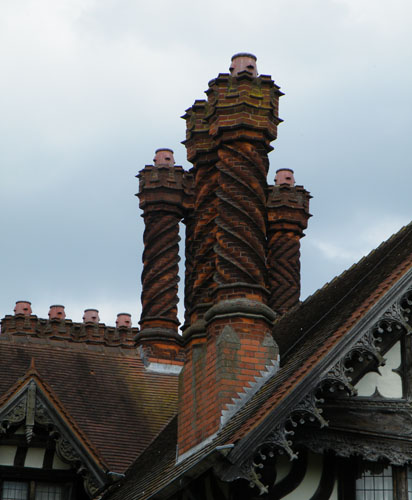
The exterior of the house is also really something, particularly some of the architectural and decorative elements. Here are some of my favourites….


More info http://www.nationaltrust.org.uk/main/w-wightwickmanor